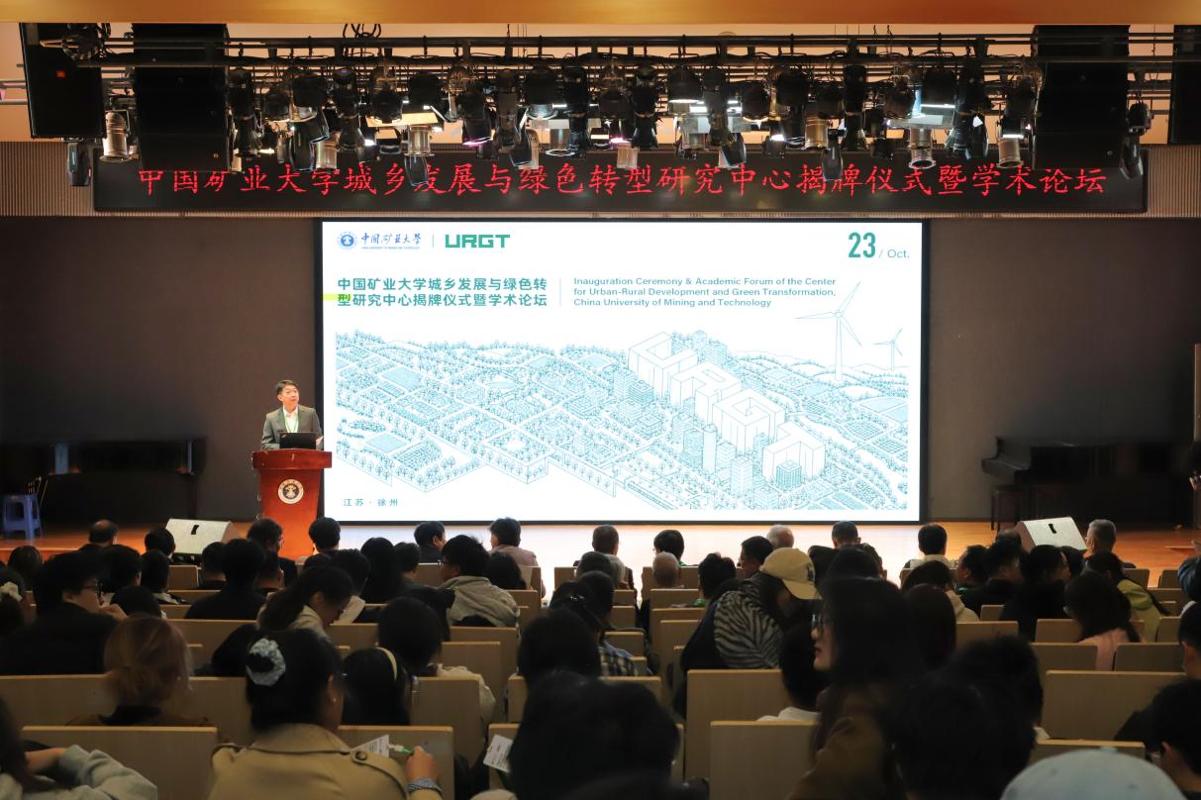
Event Scene
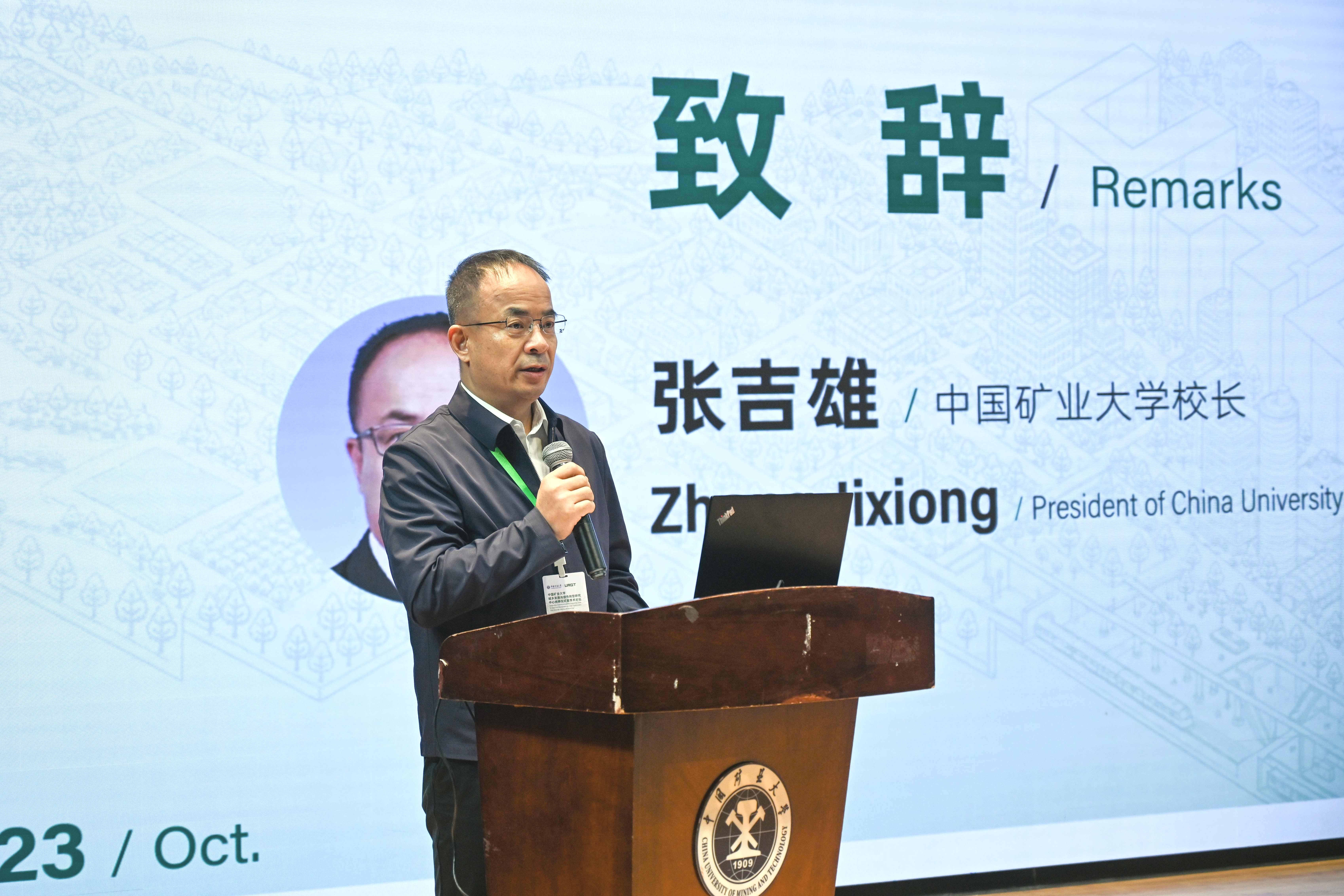
President of CUMT Zhang Jixiong delivering an address
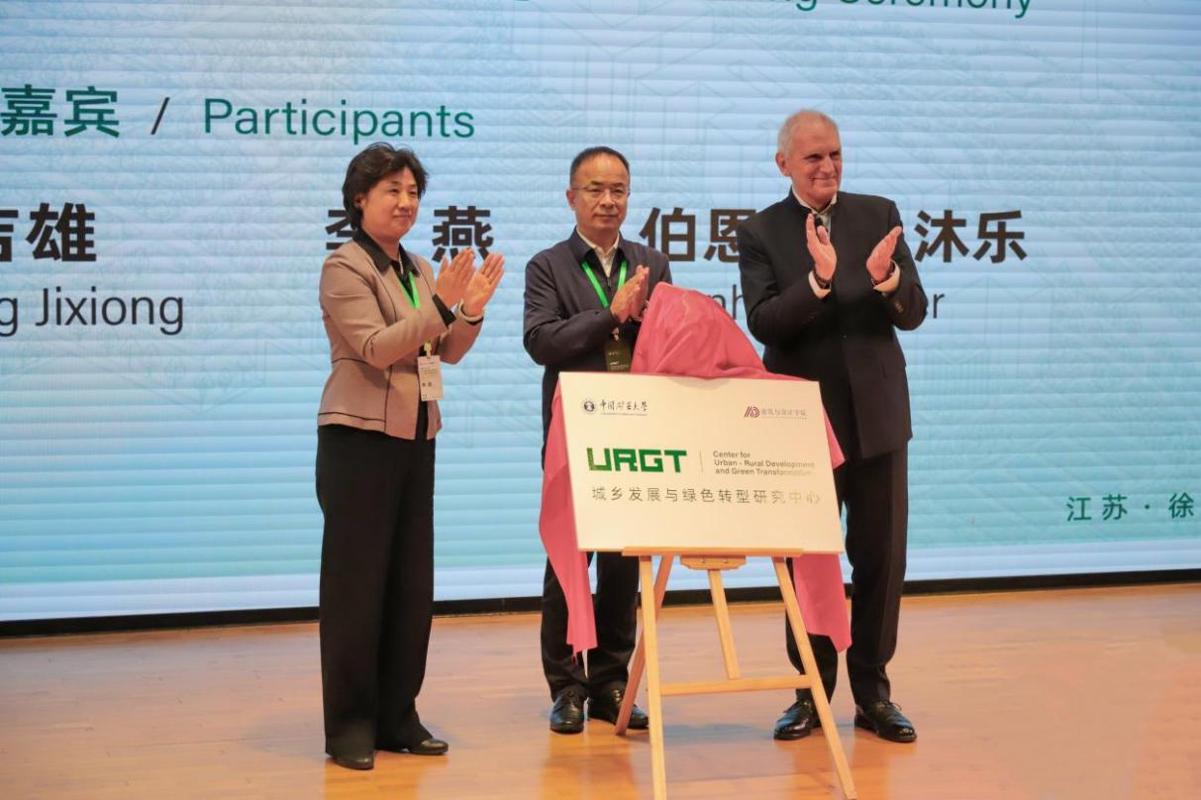
Unveiling Ceremony of the Research Center
On October 23, the Unveiling Ceremony and Academic Forum of the Urban-Rural Development and Green Transition (URGT) Research Center of China University of Mining and Technology (CUMT) was held in the lecture hall of the School of Architecture and Design. academicians, experts, scholars, and industry representatives from China and abroad gathered to conduct in-depth discussions on the topic of urban green transition and jointly contribute wisdom to promoting sustainable urban and rural development.
Attending the event were President Zhang Jixiong of CUMT; Li Yan, Deputy Director of the Standing Committee of the Xuzhou Municipal People’s Congress, Vice Chair of the Jiangsu Provincial Committee of the Revolutionary Committee of the Chinese Kuomintang (RCCK), and Chairwoman of the Xuzhou Municipal Committee of the RCCK; Academician Zhao Yuemin of the Chinese Academy of Engineering and Director of the CUMT Academic Committee; Academician Hu Zhenqi of the Chinese Academy of Engineering; Foreign Academician Bernhard Müller of the Chinese Academy of Engineering; and Foreign Academician Kang Jian of the Chinese Academy of Engineering and Professor at University College London, UK. Academician Qiu Baoxing of the International Eurasian Academy of Sciences, former Minister of Housing and Urban-Rural Development, and Party Secretary of the China Society for Urban Studies, and Qiu Shike, Vice President of the Henan Academy of Sciences, sent written congratulatory letters for the establishment of the Research Center. Li Xiangyu, Dean of the School of Architecture and Design, chaired the opening ceremony.
At the opening ceremony, Zhang Jixiong delivered an address on behalf of CUMT, and jointly unveiled the Research Center with Li Yan and Academician Bernhard Müller. He pointed out that urban-rural development and green transition are important missions for promoting high-quality economic and social development. The establishment of the URGT Research Center is an important layout for the university to serve the national “dual carbon” strategy and deeply engage in urban-rural green development. He expressed the hope that the Center would focus on its distinctive energy and resource characteristics, integrate multidisciplinary research forces from within and outside the university, gather the wisdom of domestic and international experts, connect the entire chain of theoretical exploration, technological innovation, and practical application, grow into an academic exchange and cooperation platform with international influence, strive to produce landmark achievements that reflect CUMT’s heritage and possess practical value, assist the university’s high-quality development, and contribute more insights and greater strength to China’s sustainable urban-rural development and green, low-carbon transition.
Li Yan, Academician Zhao Yuemin, Academician Hu Zhenqi, Academician Kang Jian, Michele Bonino, Dean of the Department of Architecture and Design at Politecnico di Torino, Italy, and Luo Pingjia, Party Secretary of the School of Architecture and Design at CUMT, delivered addresses successively. Academician Bernhard Müller introduced the construction of the Research Center from aspects such as its background, overall positioning, research directions, and development vision. He stated that urban-rural development and green transition are important issues for advancing new urbanization and high-quality economic and social development. The Research Center will promote interdisciplinary research and domestic and international academic cooperation, advance the integration of scientific research innovation with urban-rural development practice, and provide scientific and technological as well as talent support for the green transition and development of Xuzhou and China with more achievements.
During the specially invited academic report session, Qiu Baoxing delivered a video report titled “Analysis of Carbon Reduction Pathways in Three Common Urban Fields”; Wang Kai, National Engineering Survey and Design Master, President of the China Association of City Planning, and former President of the China Academy of Urban Planning and Design, introduced “Green-Oriented Development Trends and Spatial Optimization Technologies of Chinese Urban Agglomerations”; Zhang Jie, National Engineering Survey and Design Master and Professor at the School of Architecture of Tsinghua University, delivered a report focusing on “‘Cultural Context Field’ Leading the Protection and Renewal of Old Factory Areas"; and Michele Bonino elaborated on "Transition: Connection and Practice.”
The academic forum featured three roundtable discussions: “Multiple Perspectives on the Green Transition of Urban Development,” “Low-Carbon Development and Underground Space Development,” and “Green Transition from the Perspective of Urban Renewal and Heritage Protection.” Participating guests engaged in in-depth discussions on topics such as urban low-carbon development, underground space development and utilization, and urban renewal and heritage protection.