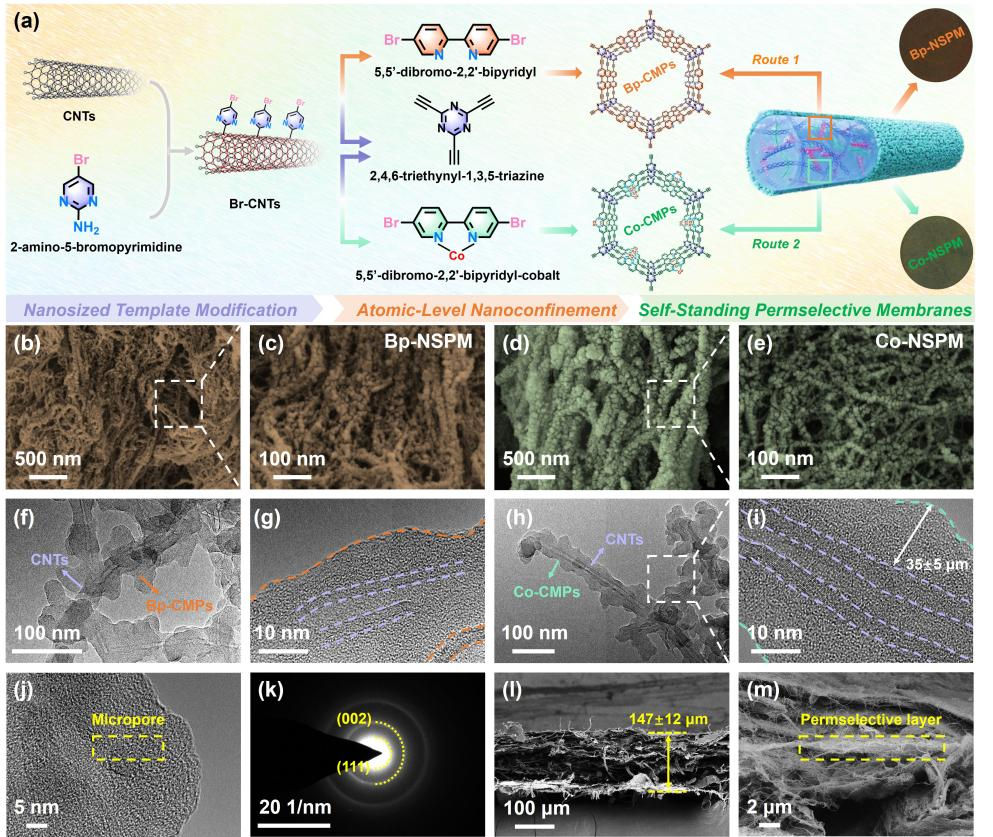
Design of Nano-confined Membranes and the Process of
Multilevel Structural Evolution
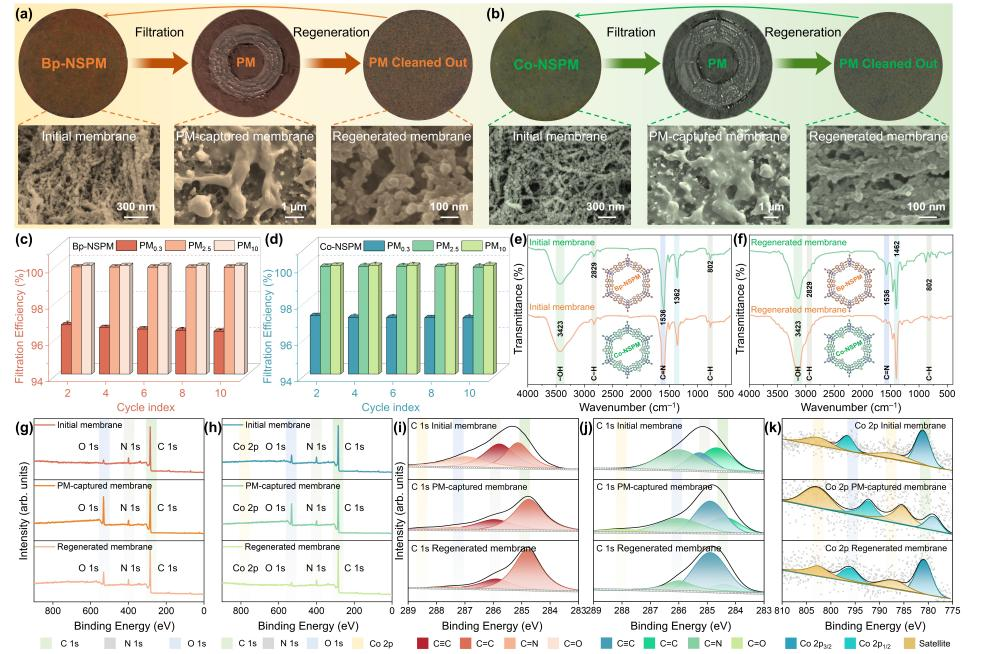
NSPMs Exhibiting Structural Stability and Performance Recovery
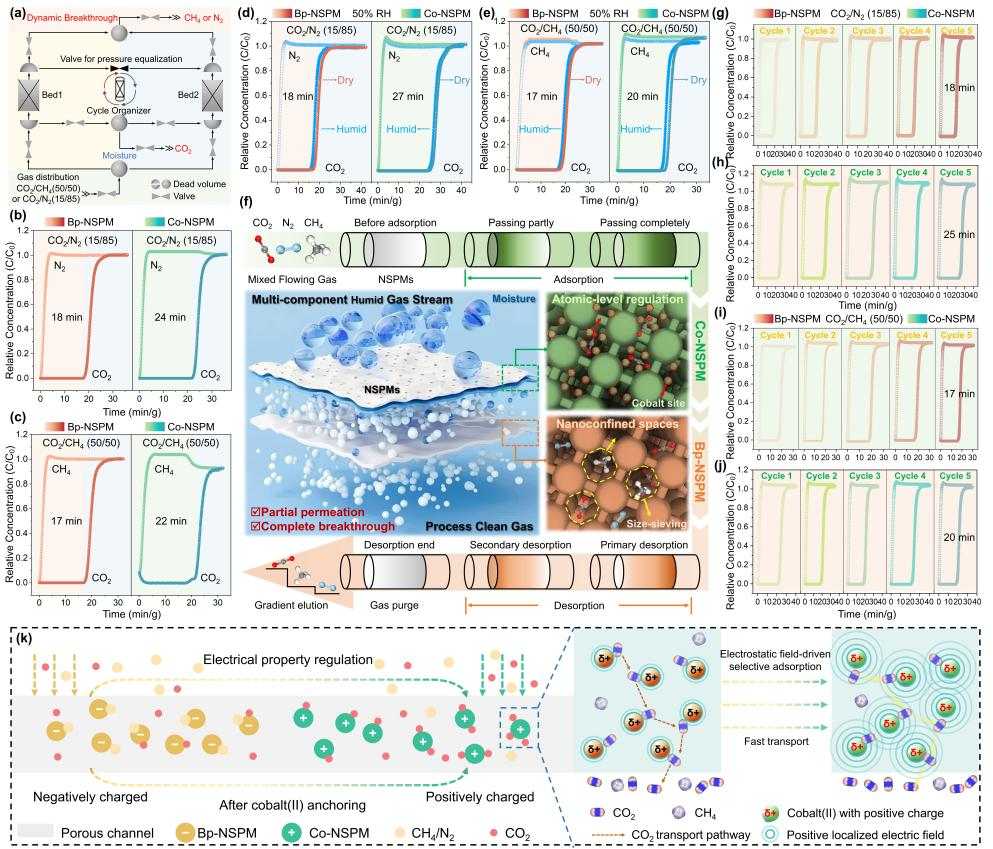
Separation Efficiency and Mechanism in Realistic Gas Mixtures
Recently, a research team led by Professor He Xinjian from CUMT has developed a breakthrough separation membrane using an "atomic-level nanoconfinement" strategy. The innovative membrane, constructed within a polymer framework with angstrom-sized cavities and atomically dispersed cobalt sites, demonstrates exceptional efficiency in pollutant recognition and separation. The research, titled Atomic-Level Nanoconfinement Strategy for Self-Standing Permselective Membranes Enabling Precise Recognition of CO2 in Multiphase Pollutants, has been published in the prestigious materials science journal Advanced Functional Materials (CAS Q1 TOP, Impact Factor: 19). The paper lists CUMT's School of Safety Engineering as the primary affiliation, with doctoral student Wang Shaozhen from the Safety Science and Engineering program as the first author. The study was conducted under the guidance of Professor He Xinjian and Associate Professor Xu Huan, with support from the National Key Research and Development Program and the National Natural Science Foundation of China.
Based on molecular structure design, the team achieved simultaneous in-situ growth of CMPs active layers and atomic-level anchoring of cobalt sites on brominated carbon nanotube surfaces, creating a self-supporting composite membrane with a well-defined core-shell architecture. Results confirmed that CNTs guided the directional polymerization of CMPs to form a uniform coating layer without causing phase separation upon cobalt site introduction. Further structural analysis revealed the material's unique "locally ordered crystalline domains - globally amorphous framework" composite characteristic. This heterogeneous structure not only facilitates gas molecule diffusion but also enhances mechanical and topological stability, establishing a structural foundation for subsequent electric-field-enhanced molecular sieving. Through multi-dimensional spectroscopy and pore structure analysis, the regulatory effect of directional cobalt site anchoring on the electronic structure of the CMPs framework and the pore channel microenvironment was systematically elucidated. A blueshift in the C=N peak in FTIR confirmed the stable coordination between Co2+ and bipyridine, while solid-state 13C NMR and XRD verified structural integrity and biphasic characteristics. Nitrogen adsorption results showed that the cobalt-functionalized membrane possessed higher specific surface area and micropore volume. Pore size distribution curves indicated that cobalt sites induced pore size contraction through spatial and electronic effects, forming a hierarchical sieving pore system that provides an ideal nanoconfinement environment for efficient CO2 recognition and capture. The Co-NSPM membrane demonstrated excellent CO adsorption capacity (3.37 mmol • g-¹) at 273 K and 1.0 bar, with IAST selectivity for CO2/N2 and CO2/CH₄reaching 230 and 75, respectively. Analysis of adsorption isotherms and adsorption heat indicated the presence of energetically heterogeneous adsorption sites within the material's channels, promoting local CO2 enrichment around cobalt active centers. This novel adsorption mechanism, combining atomic-level spatial confinement with local electric fields, overcomes the traditional trade-off between adsorption capacity and selectivity, offering a new pathway for developing efficient carbon capture materials.
This study successfully creates a dual-functional membrane material capable of simultaneous CO2 selective separation and PM particulate matter interception through synergistic atomic-level metal sites and nanoconfinement effects, breaking through the limitations of traditional materials regarding adsorption capacity and selectivity. By combining local electric fields with size-sieving mechanisms, the material achieves precise CO2 recognition and deep interception of ultrafine particles, providing a new paradigm and theoretical basis for developing high-performance personal protection and environmental remediation materials.
Paper Link:https://doi.org/10.1002/adfm.202521019