School of Chemical Engineering and Technology Makes Significant Progress in Catalyst Design for Efficient Conversion of Phenolic Compounds
Publisher : Time : 31.December 2025 Browse the number :
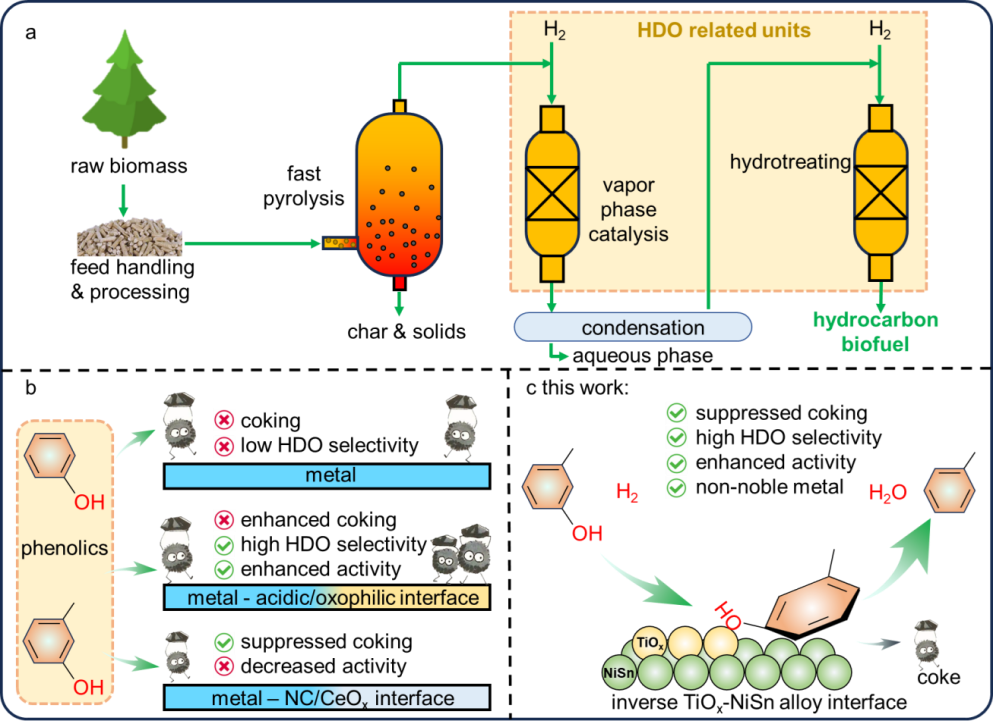
Recently, School of Chemical Engineering and Technology at CUMT, in collaboration with Academician Ma Ding from Peking University and Professor Yi Xiaodong from Xiamen University, has achieved important progress in the research on catalytic hydrodeoxygenation conversion of phenolic compounds. The study innovatively proposed a catalyst design strategy of "inverse oxide–alloy interface," successfully developing a new type of catalyst that is highly efficient, cost-effective, and exhibits significantly improved stability. This provides a new approach for the efficient, low-cost, and high-value conversion and utilization of low-rank coal and biomass.
Catalytic hydrodeoxygenation is a key technology for converting phenolic compounds derived from low-rank coal and biomass into fine chemicals and specialty oils. However, phenolic compounds have high viscosity and poor stability, and catalysts are prone to rapid coking and deactivation under atmospheric pressure, which has become a major bottleneck restricting the development of this technology. To address this challenge, the research team designed and prepared a TiOx-modified NiSn/SiO2 catalyst. Experimental results show that under mild reaction conditions of 350 °C and atmospheric hydrogen, this catalyst demonstrates excellent performance in the hydrodeoxygenation of m-cresol—with nearly 100% deoxygenation selectivity—and its anti-coking ability and stability are significantly superior to those of traditional catalysts.
Mechanistic studies reveal that its outstanding performance stems from the synergistic effects of three advantages:
· The unique interface formed between TiOx and NiSn alloy effectively reduces the energy barrier for C–O bond cleavage;
· The introduction of Sn suppresses side reactions such as over-hydrogenation, reducing the generation of coke precursors;
· The innovative "inverse modification" strategy constructs an efficient active interface while minimizing the formation of acidic sites that are prone to cause coking.
This work not only develops a high-performance catalyst with potential application prospects, but also provides a universal new strategy for the rational design of efficient and stable hydrodeoxygenation catalysts. It holds significant scientific value and application potential for promoting the high-value utilization of low-rank coal and biomass resources.
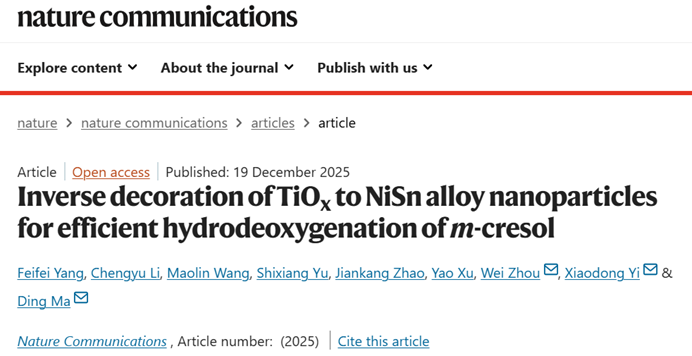
The above research findings were recently published in the internationally renowned academic journal Nature Communications under the title "Inverse decoration of TiOx to NiSn alloy nanoparticles for efficient hydrodeoxygenation of m-cresol."