Interfacial Engineering and Multifunctional Synergy of Cross‑Scale Mechanically
Interlocked PLA Nanofibrous Membranes
CSMI-PLA Nanofibrous Membranes: Low-Resistance Filtration Performance
and Synergistic Capture Mechanism
On August 4, the internationally renowned academic journal Advanced Materials (a Nature Index journal, Impact Factor: 29.1) published online a research achievement by the team of Professor He Xinjian from the School of Safety Engineering at China University of Mining and Technology (CUMT).
The paper is titled “Record selectivity of SO₂ by molecularly gated sieving membranes having cross-scale mechanically interlocked nanofibers.” The first author is Wang Shaozhen, a 2025 doctoral student, and the work was supervised by Professor He Xinjian and Associate Professor Xu Huan.
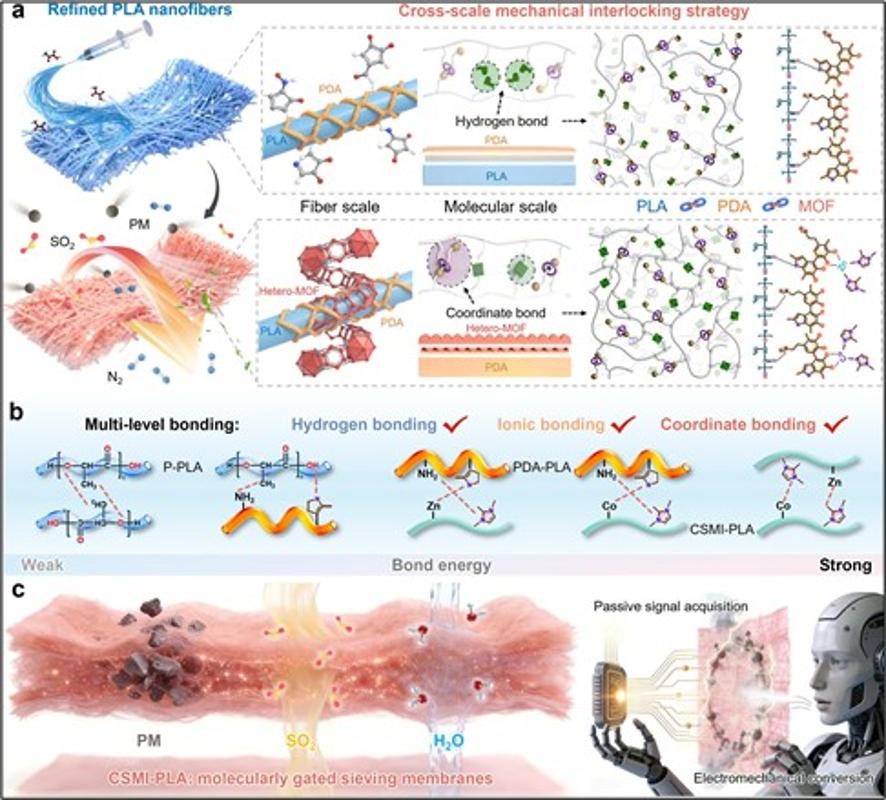
The operational environment in deep underground engineering is complex and harsh, often accompanied by high humidity, high dust levels, and the coexistence of multiple toxic and hazardous gases. How to achieve efficient filtration of particulate matter and precise selective separation of toxic gases under extreme conditions, while also possessing passive sensing capabilities, has become a frontier challenge in the fields of deep underground safety protection and advanced separation membrane materials. To address this challenge, the team innovatively proposed a “cross-scale mechanical interlocking” strategy. Using asymmetric phase-separation electrospinning technology, they constructed a polylactic acid (PLA) nanofiber network with a hierarchical structure. The resulting CSMI-PLA composite membrane maintained stable selective separation performance and passive sensing capabilities even in harsh environments characterized by high humidity, high dust, and coexisting multiple gases, demonstrating promising application prospects.
The study elucidated the core design principles of the CSMI-PLA nanofiber membrane and introduced the concept of “programmable fiber interfaces.” A porous PLA framework was constructed via asymmetric phase-separation electrospinning; dopamine infiltrated the fiber surface and polymerized oxidatively to form PDA, establishing a primary interlocking interface through a dynamic hydrogen-bonding network between catechol/amino groups and PLA hydroxyl/carbonyl groups. The concave-convex sites on the fiber surface enriched metal ions, inducing localized nucleation and epitaxial growth of hetero-MOF, forming a “mortise-and-tenon” secondary interlocking interface with the polymer. Thus, the traditional planar contact interface was replaced by three-dimensional mechanically anchored nodes, allowing interfacial stress to be progressively transferred and dissipated along molecular bonding, nanocrystals, and fiber networks.
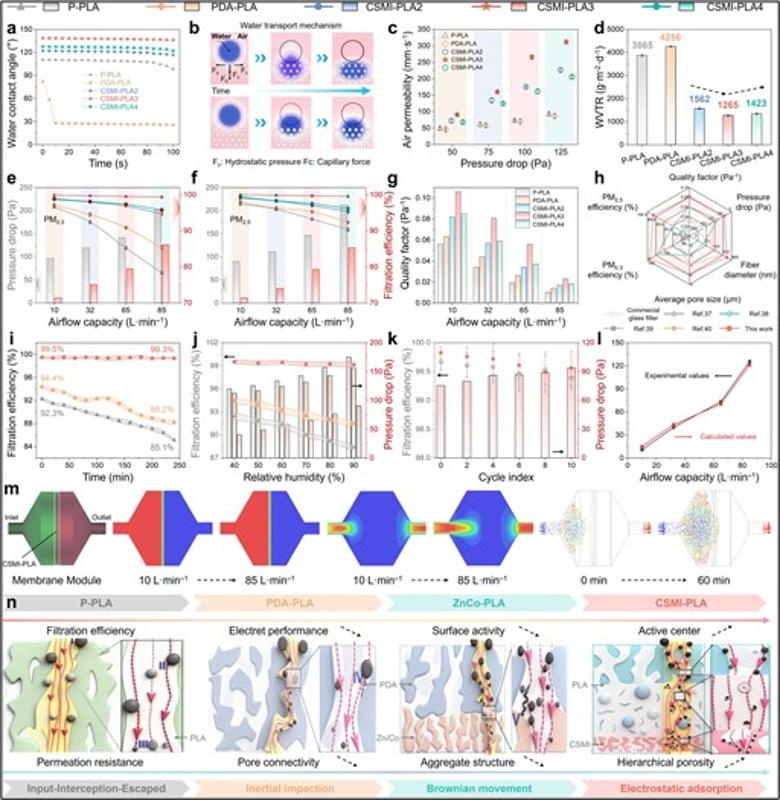
Based on a biodegradable PLA framework, this study proposed a cross-scale interlocking strategy synergizing PDA hydrogen-bonding adhesion and hetero-MOF coordination–topological entanglement, constructing a “molecular bonding–nanoscale occlusion–micrometer network” three-level interconnected structure. Under high-flow, high-humidity, and dust-laden multicomponent conditions, the material exhibits efficient PM0.3 filtration, record-breaking SO₂/N₂ selectivity, and stable cyclic separation performance. This strategy transforms flexible functional layers from two-dimensional interfacial adhesion to three-dimensional topological anchoring, providing a versatile interfacial paradigm for the long-term integration of porous crystalline functional layers and laying a foundation for the design of membrane materials for industrial purification, respiratory protection, and intelligent wearables.
Link: https://doi.org/10.1002/adma.74439