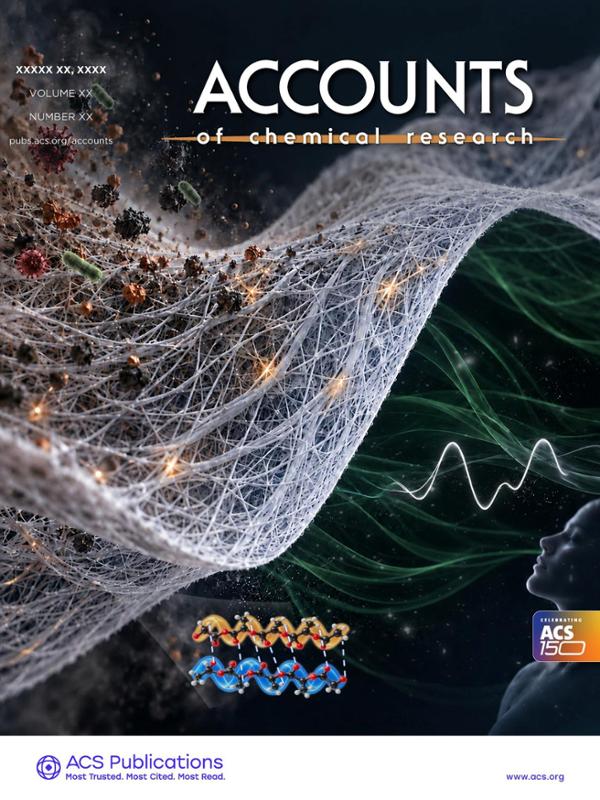
Recently, the research team of Professor He Xinjian from the School of Safety Engineering at China University of Mining and Technology (CUMT) was invited to publish a review paper titled “Beyond Long-Term Protection by Intelligent Poly(lactic acid) Nanofibers: Structuring Multiscale Hierarchies for Passive Sensing” in the top international chemistry journal Accounts of Chemical Research. The paper was selected as a cover article. Accounts of Chemical Research is one of the three most influential review journals in the field of chemistry, with a five-year average impact factor of 20.5. The journal is by invitation only, exclusively inviting international scholars who have made outstanding achievements and established systematic work in a specific direction. The first author of the paper is Wang Shaozhen, a 2025-entry doctoral student in Safety Engineering at CUMT, and the research was conducted under the supervision of Professor He Xinjian and Associate Professor Xu Huan, with support from the National Key Research and Development Program of China and the National Natural Science Foundation of China.
Polylactic acid (PLA) is a renewable and biodegradable bio-based polymer with significant value in functional materials for personal protection. By regulating multiscale structures, PLA fibers can be endowed with charge storage and electromechanical transduction capabilities, which can be used for air purification and self-powered health monitoring, expanding their application in the field of smart wearables. However, PLA faces issues such as insufficient dipole coordination, weak dielectric response, and shallow charge traps. How to synergistically achieve efficient particle capture, low-resistance airflow transport, and stable electrical signal output remains an urgent scientific problem to be solved.
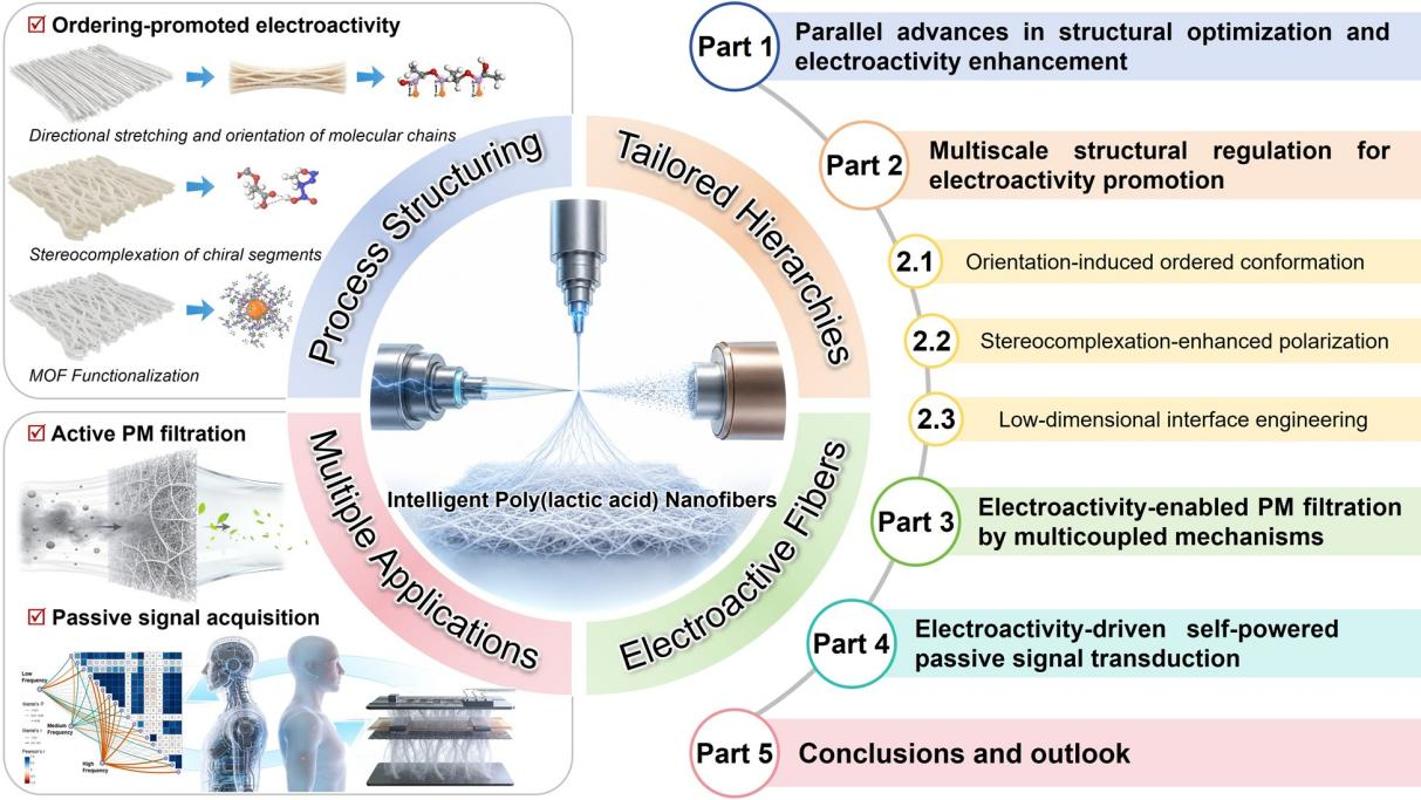
Against this background, the paper systematically summarizes the research group’s progress in recent years regarding multi-scale structural regulation of PLA fibers for long-term protection and passive sensing: First, targeting the issues of insufficient intrinsic electroactivity and easy charge dissipation, a synergistic regulation system involving oriented crystallization, stereocomplexation, and filler interfaces was constructed. Through electric-field stretching, chain segment orientation and dipole alignment are promoted; stereocomplexation is utilized to enhance polarization and deepen traps; and functionalized dielectrics are introduced to construct dielectric heterointerfaces and multilevel trapping sites, establishing a cross-scale regulation pathway from molecular ordering to interfacial charge storage stabilization. Second, by synergistically designing electrostatic capture and pore transport, the synergistic effects of the fiber network and electroactive interfaces on airflow transport and particle capture were elucidated. By optimizing pore connectivity, flow resistance is reduced, electrostatic capture is enhanced, and the attenuation of capture capacity is delayed, providing a basis for mitigating the trade-off between filtration efficiency and airflow resistance. Third, by combining interfacial charge regulation with electromechanical transduction, the coupling relationship among contact electrification, electrostatic induction, and trap charge storage was revealed. Through core-shell confinement and micro-nano interface regulation, the effective contact area, local polarization, and charge dissipation are modulated, converting mechanical disturbances into electrical signals. Combined with machine learning to extract respiratory waveform features, this promotes the integrated development of bio-based fibers towards protection and self-powered sensing.
In summary, the research group’s related findings provide theoretical basis and technical support for cross-scale charge regulation and synergistic protection-sensing of PLA fibers, opening a new design pathway for bio-based smart fibers that connects “molecular polarity synergy with macroscopic electroactive construction.”
Over the past five years, Professor He Xinjian’s team has carried out extensive research on high-performance personal protective materials, focusing on multi-scale structural regulation of biodegradable polymers and the construction of functional heterointerfaces, achieving a series of representative results. The related research findings have been successively published in international authoritative journals such as Acc. Chem. Res. (2026), Nat. Commun. (2026), Adv. Mater. (2026), Adv. Funct. Mater. (2026), Chem. Eng. J. (2026/2025), J. Hazard. Mater. (2026/2025/2024/2023), and ACS Sustain. Chem. Eng. (2025/2024/2023), receiving widespread attention from the domestic and international academic communities.
Original link: https://doi.org/10.1021/acs.accounts.6c00652