Research outcomes
Recently, undergraduates from the School of Computer Science and Technology / School of Artificial Intelligence at China University of Mining and Technology (CUMT) have made new research progress in the fields of computer security and artificial intelligence. Two research outcomes have been accepted by top-tier international academic conferences.
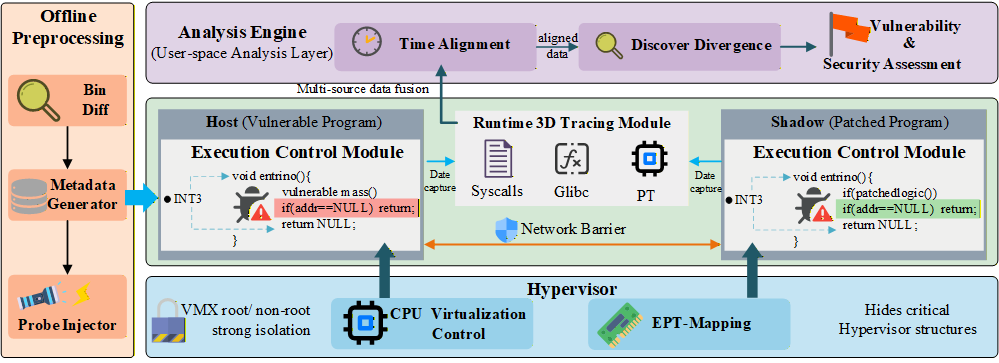
The research outcome titled “A Shadow Verification Method for Hot-patch” from the System Security Laboratory has been accepted as a Short Paper + Poster by the IEEE Symposium on Security and Privacy (IEEE S&P), a top-tier international academic conference. This work was completed collaboratively by several members of the laboratory, including three undergraduate students and one graduate student. The corresponding author is Associate Professor Li Yonggang. This research focuses on the security assessment of hot patches for closed-source software. In real-world industrial scenarios, commercial software is typically distributed in binary form, and its patching mechanisms also lack source�code support, creating a “double black box” dilemma where neither the program nor the patch is visible. In such a highly opaque environment, the security of patches is difficult to verify effectively, potentially leading to risks such as incomplete vulnerability fixes, program anomalies, or even hidden backdoors. To address this critical challenge, the research team designed and implemented an automated analysis framework named Spatch based on a lightweight hypervisor. This method features a dual�system synchronous execution mechanism, multi-dimensional collaborative tracing technology, and fine-grained differential analysis capabilities.
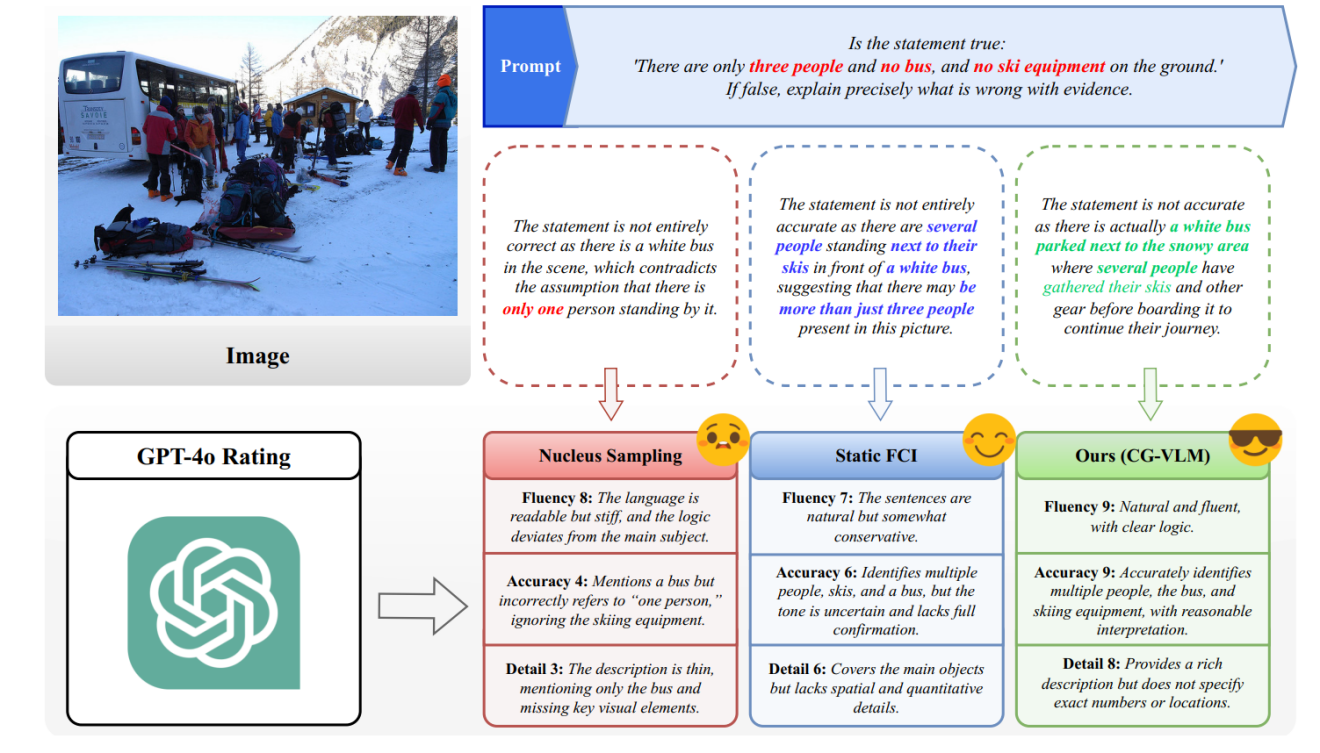
In another achievement, Bu Weijue, an undergraduate student of Computer Science and Technology, as first author, has recently had his research paper titled “Conscious Gaze: Adaptive Attention Mechanisms for Hallucination Mitigation in Vision-Language Models” accepted by the IEEE International Conference on Multimedia and Expo (ICME), a flagship conference in the multimedia field. The paper addresses the widespread problem of object hallucination in vision�language models and innovatively proposes a “conscious gaze” correction framework for vision�language models, termed Conscious Gaze for VLM (CG�VLM). The corresponding author is Professor Yuan Guan. This research focuses on hallucination issues in large vision�language models caused by “text inertia”. The CG�VLM framework achieves a technological leap from “external output intervention” to “internal attention intervention”, performing dynamic correction directly at the inference source. CG�VLM is a training-free, inference�time intervention framework comprising two highly synergistic core modules: a cognitive demand sensor and a focused consensus inducer. As a plug�and�play lightweight plugin, CG�VLM demonstrates excellent architectural generalization and can be seamlessly integrated into various mainstream models such as InstructBLIP, LLaVA, and Qwen�VL. On benchmark tests such as POPE and CHAIR, this method not only significantly reduces the occurrence of hallucinations but also well maintains the fluency of generated text and the model’s original cross-modal understanding capabilities.
The IEEE Symposium on Security and Privacy (IEEE S&P) is the most influential international conference in the field of computer security and privacy protection, recognized as a Category A conference by the China Computer Federation (CCF). Spatch represents the first research outcome in CUMT’s history to be published at this conference. IEEE ICME is jointly sponsored by the IEEE Signal Processing Society, Communications Society, Computer Society, and Circuits and Systems Society. It is a flagship international conference in the field of multimedia technology and applications, and is recognized as a Category B conference by the CCF. The conference aims to facilitate the exchange and collaboration of the latest research results in multimedia technology, systems, and applications within the global research community, attracting participants from top universities, research institutions, and technology companies around the world each year.
In recent years, the School of Computer Science and Technology / School of Artificial Intelligence has placed great emphasis on the quality of talent cultivation. It has actively built platforms for scientific innovation, guided students to participate in research projects and innovation competitions, and strived to enhance students’ innovative thinking and practical abilities. As a result, a number of outstanding students with strong research and practical capabilities have been cultivated, demonstrating the distinctive features and effectiveness of the school’s talent cultivation.