Research findings
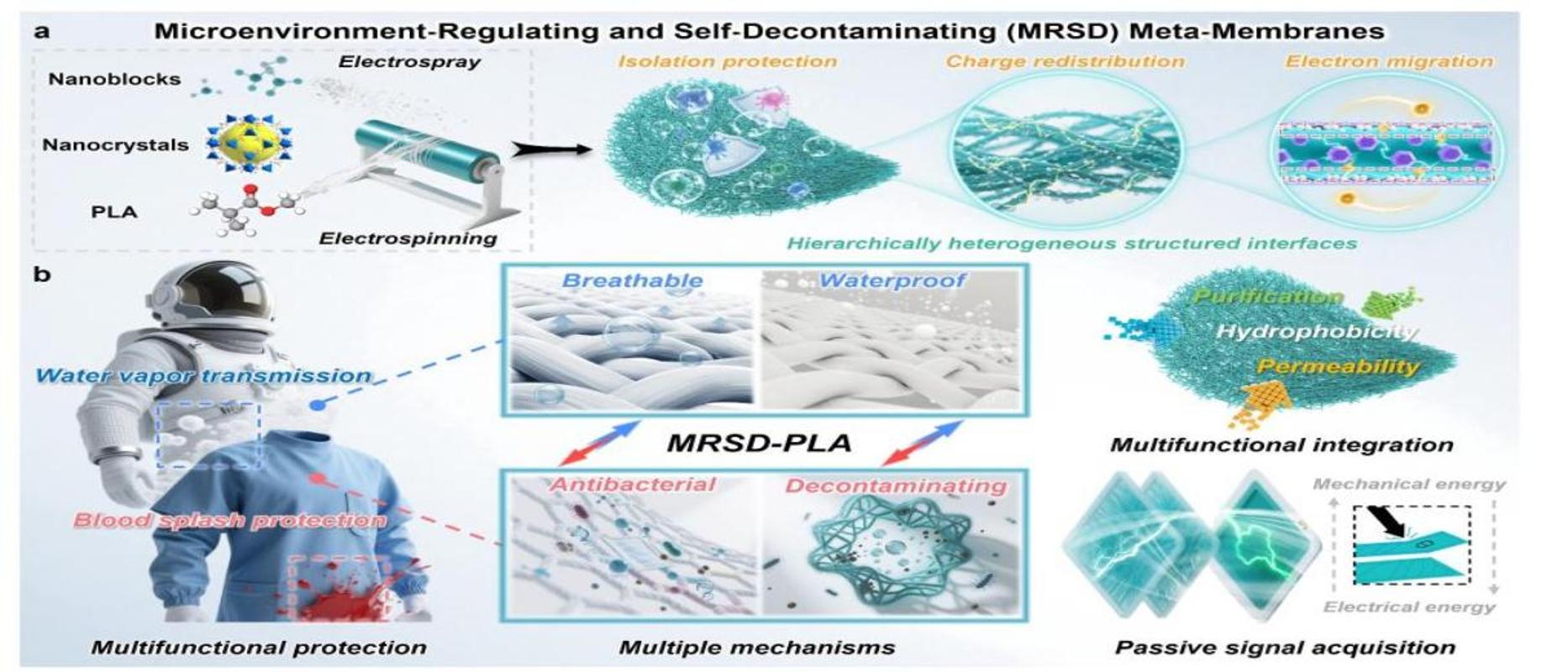
Synthesis route and application scenarios of MRSD-PLA metamaterial membrane
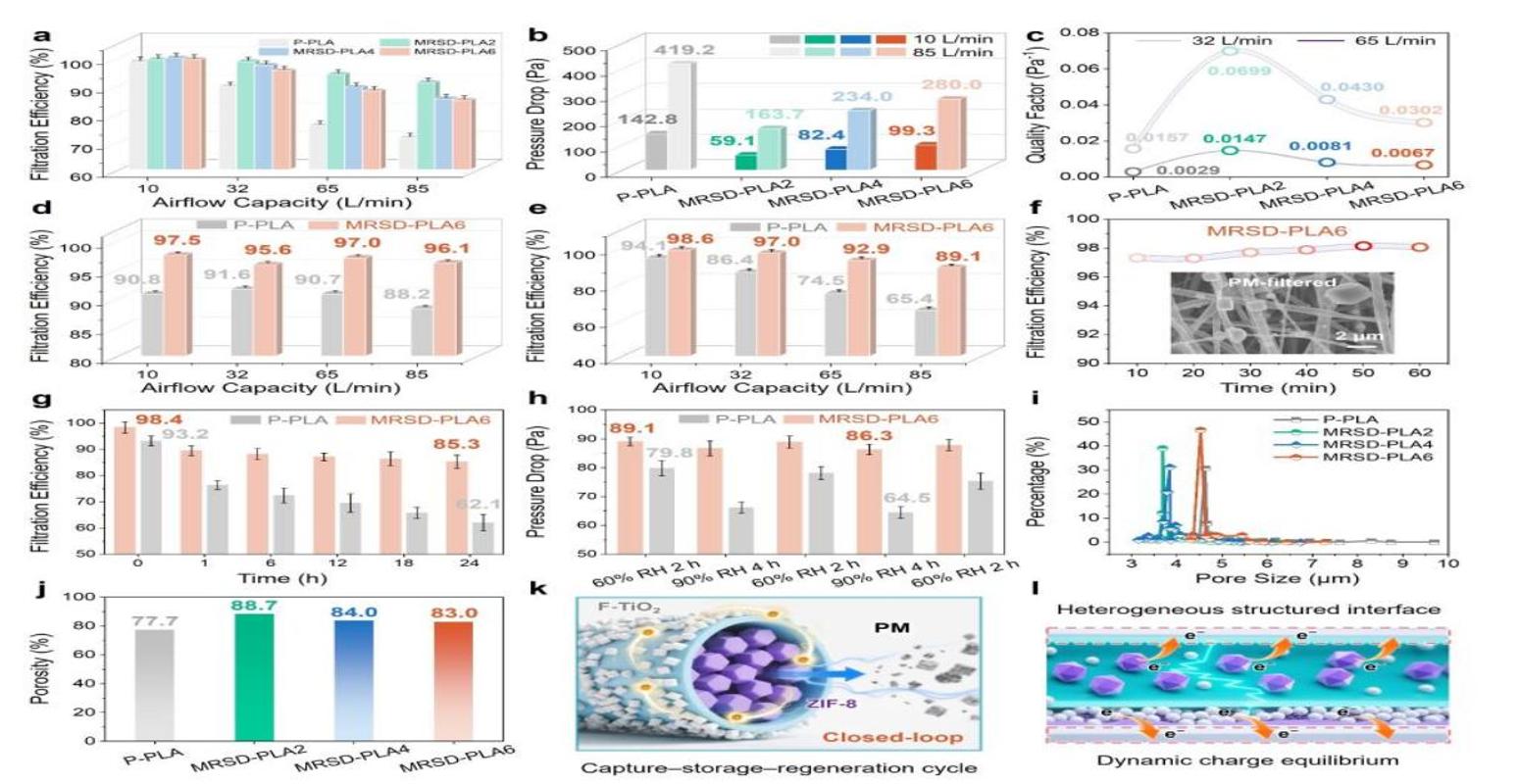
Air filtration performance and mechanism of MRSD-PLA membrane
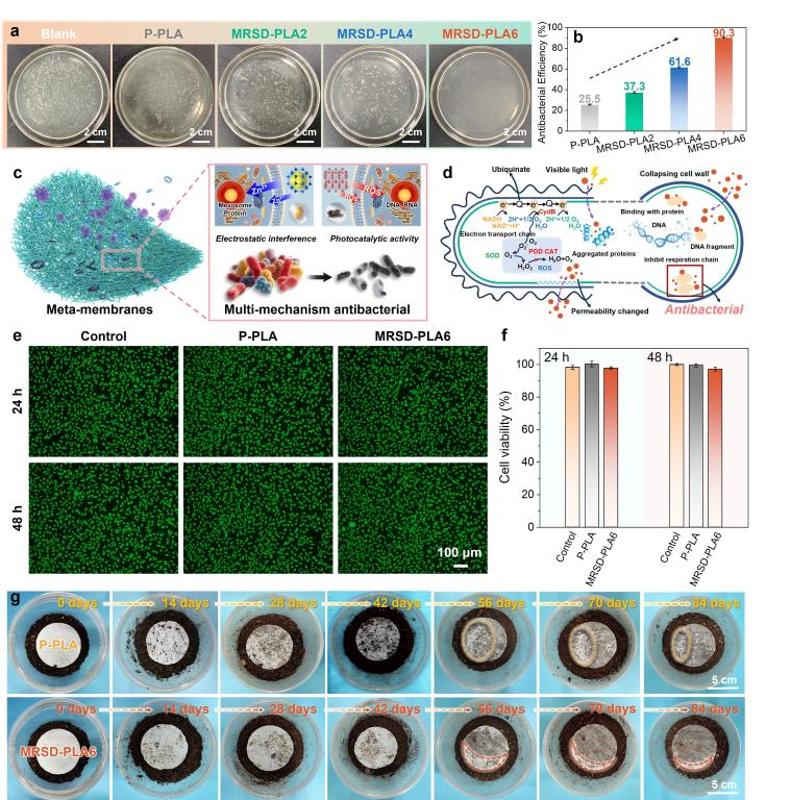
Antibacterial mechanism and composting degradation behavior of MRSD-PLA membrane
On May 8, Nature Communications, an internationally renowned academic journal and a sub-journal of Nature, published online a research achievement by the team of Professor He Xinjian from the School of Safety Engineering at China University of Mining and Technology (CUMT). The paper is titled “Hierarchically heterogeneous interface structuring strategy for microenvironment�regulating and self-decontaminating biodegradable meta�membranes.” This marks the first time that CUMT’s safety discipline has published a paper as the corresponding author unit in this journal, signifying a major breakthrough in the discipline.
The study was conducted at CUMT’s School of Safety Engineering as the first affiliation. The first author is Wang Shaozhen, a 2025 doctoral student of the School, and the work was supervised by Professor He Xinjian and Associate Professor Xu Huan. The research was supported by the National Key Research and Development Program of China and the National Natural Science Foundation of China. The team constructed a meta�membrane with microenvironment�regulating and self-cleaning functions through a “hierarchically heterogeneous interface structuring” strategy, achieving efficient protection against particulate matter and harmful microorganisms as well as synergistic regulation of thermal�moisture comfort.
The research employed an electrospinning�electrospray technique to construct the hierarchically heterogeneous interface structure. Biodegradable PLA nanofibers were used as the scaffold, into which highly porous, electroactive ZIF�8 nanocrystals were embedded. Their ordered microporous channels enabled directional transport of water vapor and air, while abundant unsaturated coordination sites served as charge storage traps. On the fiber surface, low�surface�energy, highly electronegative F�TiO₂ nanoblocks were anchored, endowing the membrane with hydrophobic self-cleaning functionality and creating deep charge traps. The resulting heterogeneous interface drove directional electron migration and spatial charge redistribution, establishing a “capture�storage�regeneration” closed-loop charge cycling mechanism that maintained stable surface potential even under high humidity conditions.
In air purification tests, the MRSD�PLA6 membrane exhibited over 99.1% filtration efficiency for PM0.3, a pressure drop of only 51.9 Pa, and a quality factor of 0.11 Pa⁻¹. After water washing and treatment at 90% relative humidity for 24 hours, the PM2.5 filtration efficiency remained above 85.3%, confirming that the closed-loop charge mechanism effectively suppressed humidity-induced performance degradation. Pore size analysis revealed abundant micropores and mesopores within the membrane. The filtration mechanism is explained as follows: ZIF�8 micropores provide nanoscale interception channels and charge storage sites, while F�TiO₂ creates deep surface charge traps and hydrophobic barriers. Their synergy enables efficient electrostatic capture of multiscale particles and low�pressure�drop physical sieving.
Antimicrobial tests showed that the MRSD�PLA6 membrane achieved over 90.3% antibacterial rates against Escherichia coli and Staphylococcus aureus. Its multi-mechanism synergistic antibacterial action is attributed to: Zn²⁺ coordination sites from ZIF�8 and surface hydroxyl groups from F�TiO₂ cooperatively promoting the generation of reactive oxygen species (ROS) from photogenerated charge carriers reacting with O₂/H₂O. ROS penetrate bacterial cell membranes, damage nucleic acids and proteins, and inhibit nutrient transport and enzymatic activity. Cytotoxicity and live/dead staining assays confirmed the membrane’s good biosafety. Soil burial degradation experiments showed that after 84 days the membrane structure had significantly disintegrated with a mass loss exceeding 75%, demonstrating that the hierarchically heterogeneous interface structuring strategy endows the membrane with excellent service performance while preserving the inherent biodegradability of PLA.
This breakthrough overcomes the limitations of conventional single-function or single-interface designs, achieving systematic integration of multiple performances through “hierarchical interfaces + functional zoning.” Compared to simple material stacking, this structural design realizes true synergistic effects, simultaneously enhancing protective performance, comfort, and stability. Moreover, the hierarchical heterointerface design concept is highly versatile and can be extended to various fields including filtration, sensing, and energy materials.