Conference Scene
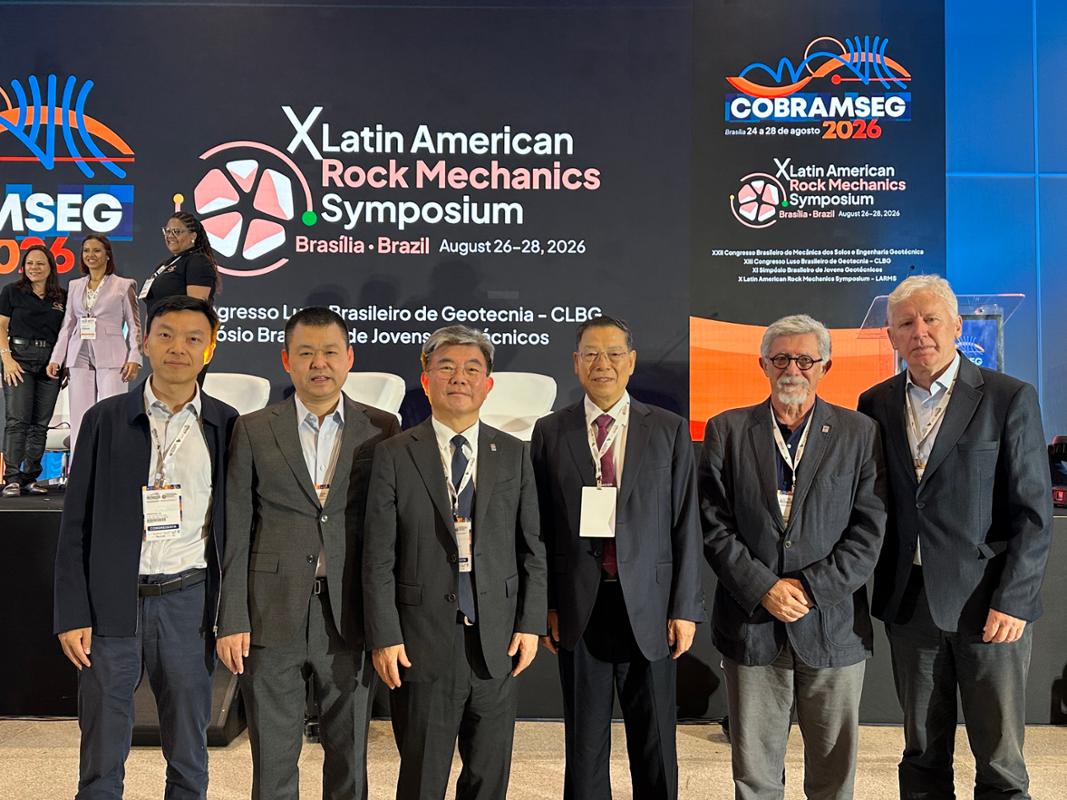
On August 26, 2026 (local time), the 10th Latin American Rock Mechanics Symposium (LARMS 2026) opened at the International Convention Center in Brasília, the capital of Brazil. The symposium was hosted by the Brazilian Committee on Rock Mechanics (CBMR), with the theme “Rock Mechanics for a Sustainable Future: Innovation in Mining, Energy and Infrastructure,” bringing together more than 540 experts and scholars in the field of rock mechanics and engineering from around the world. Academician He Manchao of the Chinese Academy of Sciences and President of the Chinese Society for Rock Mechanics and Engineering led the Chinese delegation. Professor Liu Jiangfeng, Director of the Deep Energy Substance Storage Research Center at CUMT and a faculty member of the State Key Laboratory of Intelligent Construction and Healthy Operation and Maintenance of Deep Underground Engineering, participated in the symposium as a member of the delegation.

On the afternoon of August 26, the symposium held a roundtable forum titled “Rock Mechanics for Energy Storage and CO₂ Geological Sequestration.” At the forum, Professor Liu Jiangfeng addressed the demand for large-scale CO₂ sequestration under the "dual carbon" goals, introduced the gap between global and China’s carbon emission scale and existing geological sequestration capacity, and analyzed the challenges currently facing CCUS development, including source-sink matching, full-chain cost control, and long-term monitoring, reporting, and verification (MRV). He focused on carbon storage pathways and large-scale sequestration technology systems based on underground coal mine spaces, and explored the feasibility and development potential of using underground coal mine spaces to create new CO₂ storage scenarios. During the discussion session, participating experts engaged in in-depth exchanges on issues including CO₂ geological sequestration, hazardous waste disposal, underground hydrogen storage, reservoir integrity, safety monitoring, and policy mechanisms, and reached consensus on further strengthening interdisciplinary collaboration, monitoring and evaluation, and international cooperation. During his stay in Brazil, Professor Liu Jiangfeng also visited institutions including the Pontifical Catholic University of Rio de Janeiro with the delegation, conducting exchanges on deep energy development, deep energy substance storage (carbon storage, hydrogen storage, energy storage, and waste storage), and frontier research in rock mechanics.
This invitation to the 10th Latin American Rock Mechanics Symposium is an important reflection of CUMT’s participation in international frontier exchanges in the research direction of deep energy and underground space utilization, and has enhanced the international influence of CUMT’s related research fields. In the future, the university will rely on its multidisciplinary research platforms and innovation system to further strengthen cooperation with international peers in areas such as deep energy development, underground storage of energy substances, and fundamental theories of rock mechanics, contributing CUMT’s strength to national energy security and the implementation of the "dual carbon" strategy.