Research Team from School of Environment and Spatial Informatics Achieves Major Breakthrough in Electrochemical Resource Utilization of SO₂ from Flue Gas
Publisher : Time : 02.October 2026 Browse the number :
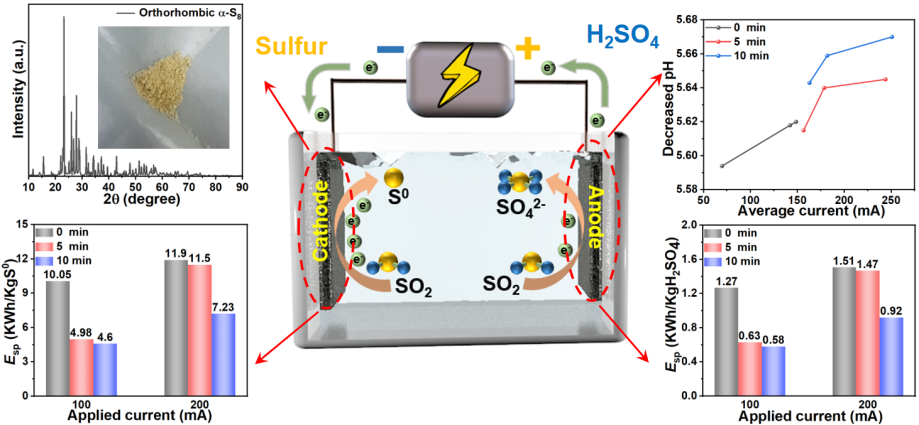
Sulfur dioxide (SO₂) in flue gas from coal combustion and mining/metallurgical processes has long been regarded as an “air pollutant.” Traditional calcium-based desulfurization converts it into low-value gypsum, generating large amounts of solid waste and significant carbon emissions. A new technology developed by the Environment and Energy Engineering (E3) research team at CUMT’s School of Environment and Spatial Informatics is upending this treatment model: it redefines SO₂ from a “pollutant” to a “sulfur resource,” electrochemically converting it simultaneously into high-value sulfuric acid (a basic industrial raw material) and elemental sulfur (a key industrial raw material for rubber, explosives, etc.), achieving a paradigm shift of “turning waste into treasure.”
The team was the first to publish a paper in Chemical Engineering Journal (IF 13.2), with doctoral student Sun Haoran as the first author and Professor Wang Lizhang as corresponding author. The results were the first to confirm the technical feasibility of simultaneously converting SO₂ into sulfuric acid and elemental sulfur under membrane-free conditions. The energy consumption for sulfuric acid production is only 0.58 kWh/kg, with an input-output ratio exceeding 2.09, indicating that the technology has significant economic potential. Taking a large power plant (annual power generation of 18 billion kWh) as an example, if this technology were used to replace traditional calcium-based desulfurization, it could reduce solid waste by 93,700 tons and carbon emissions by 30,300 tons per year.
Subsequently, the team published follow-up research results in Applied Catalysis B: Environment and Energy (IF 19.7), with doctoral student Tian Tao as first author and Professor Wang Lizhang as corresponding author. The study proposed an original electrochemical regulation method that solved the problem of efficiency fluctuations caused by changes in flue gas SO₂ concentration during the reaction process, enabling the technology to remain stable under all-weather continuous operation conditions with reliable long-term performance and continuous stable production of two sulfur products, providing key guarantees for industrial application.
In the future, the team will continue to focus on non-precious metal electrode development, operational strategy optimization, and reactor design, continuously promoting the translation of experimental results into industrial scenarios, and contributing to the synergistic enhancement of flue gas treatment and resource recovery under the “dual carbon” goals.
Links: https://doi.org/10.1016/j.cej.2026.173066