Network structural complexity and time-delay effects synergistically shape the shear of oscillations

Complexity–delay critical curves under different interaction types
Oscillation shear driven by complexity and delay observed on a hardware simulation platform
Recently, National Science Review published online the research findings of Professor Sun Yongzheng’s research group from the School of Mathematics at China University of Mining and Technology (CUMT). The paper is titled “Complexity and delay shape oscillatory transitions in complex networks.” The study reveals that network structural complexity, delay effects, and interaction types can jointly shape the transition between amplitude death and sustained oscillations in complex networks.
Oscillations are ubiquitous in biological, physical, and socio-economic systems and are important dynamical phenomena for maintaining the normal functions of complex systems. However, abnormally enhanced or suppressed oscillations can also lead to system dysfunction. Oscillatory behavior in complex networks depends not only on the dynamics of individual nodes but also on multiple factors such as network size, connectivity, interaction strength, interaction type, and information propagation delay. However, a systematic understanding of how network structural complexity and delay effects jointly influence the emergence of oscillations, and how different interaction types further regulate this process, is still lacking.
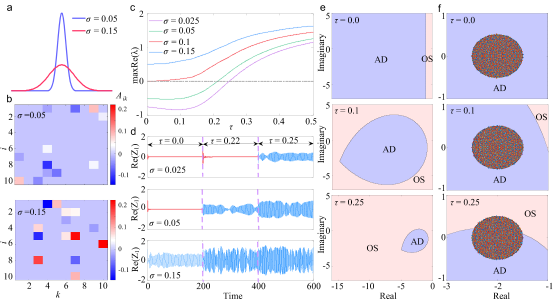
To address this issue, the research team established a new theoretical analysis framework, revealing the mechanisms by which structural complexity, delay effects, and interaction types jointly determine the transition between amplitude death and oscillation states. Using the classic Stuart–Landau oscillator network as the research object, the paper established a quantitative relationship between network structural complexity and critical delay. The results show that the higher the network complexity, the smaller the delay typically required to trigger oscillations; when network complexity exceeds a certain threshold, the system can generate sustained oscillations even in the absence of delay, as shown in Figure 1. This result reveals the synergistic effect between network structural complexity and delay effects, providing a theoretical basis for predicting the emergence of oscillations in complex systems.
The study further compared oscillatory transitions under random, mixed, cooperative, and competitive interactions. The results show that different interaction types correspond to different complexity–delay transition boundaries, as shown in Figure 2. Among them, cooperative interaction has the lowest critical complexity, generating sustained oscillations at lower complexity; mixed, competitive, and random interactions require higher critical complexity. This indicates that interaction type not only affects network structure but also changes the critical conditions under which structural complexity and delay jointly drive oscillatory transitions.
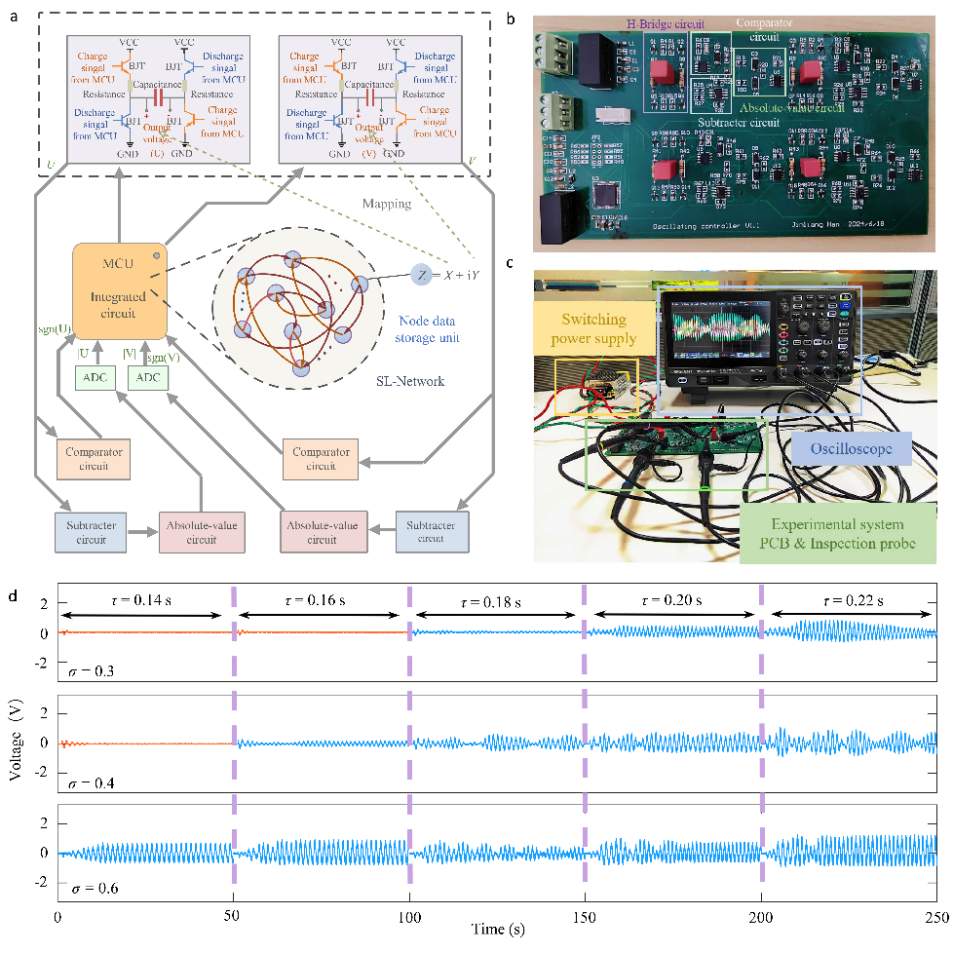
To verify the theoretical predictions, the researchers built a digital–analog hybrid hardware simulation platform composed of microcontrollers and electronic circuits, as shown in Figure 3. The microcontrollers update the oscillator network states, while the H-bridge driver and sampling circuit convert them into measurable voltage signals. The experimentally measured voltage waveforms reproduced the theoretically predicted amplitude death–sustained oscillation transition. The consistency between theoretical analysis and hardware measurement results further indicates that the revealed complexity–delay transition laws possess good robustness under hardware implementation conditions.
This study reveals the intrinsic mechanisms by which network structural complexity, delay effects, and interaction types jointly shape the amplitude death–sustained oscillation transition, providing a new perspective for understanding the generation and transition of oscillatory states in complex systems. The established structural complexity–delay critical relationship also provides a theoretical reference for studying collective dynamics under the synergistic effects of network structure and delay.